
Will AI Replace Professionals? What U.S. Workers Need to Know
Will AI replace professionals? No, not every professional. AI will replace some tasks, change many roles, and create new skill needs. That is the real shift workers need to understand.
Many people in the U.S. now ask the same question at work. They see AI write emails, build reports, create images, check data, and draft code. It is fair to wonder what comes next. The answer is clear: AI will not remove the need for people, but it will change what employers expect from people.
The safest career move is not to ignore AI. It is to learn how to use it. That may mean taking focused Micro Credentials to build one skill at a time. It may also mean joining a WorkForce Institute bootcamp for a deeper career path.
Why people ask, “Will AI replace professionals?”
Will AI replace professionals? People ask this because AI can now do work that once felt safe. It can summarize meetings, write first drafts, clean data, create plans, and answer customer questions.
This does not mean AI owns the whole job. Most jobs are made of many tasks. Some tasks are simple and repeat often. Others need judgment, trust, care, taste, ethics, and context. AI is strong with repeat work. Humans are still needed for choices that carry risk.
WEF reports that employers expect 39% of key skills in the job market to change by 2030. It also lists AI, big data, tech literacy, creative thinking, and lifelong learning as key skills on the rise.
That means the better question is not, “Will AI take my job?” The better question is, “Which parts of my job will AI change first?”
The short answer: AI changes tasks before it changes careers
Will AI replace professionals? In most cases, AI changes the work before it removes the role. A marketer may use AI to draft ad copy. A data analyst may use AI to clean a spreadsheet. A project manager may use AI to draft a status report. A designer may use AI to test ideas faster.
The person still owns the result. They must check the facts, shape the plan, explain the choice, and make sure the work fits the goal.
Microsoft’s 2026 Work Trend Index found that 66% of AI users said AI helped them spend more time on high-value work. It also found that 58% said they could now produce work they could not produce a year before.
This is why AI skills now matter in almost every career path. Workers who learn AI tools can move faster. They can also spend more time on the work that needs human judgment.
Which professionals are most at risk?
Will AI replace professionals in every field? No. But some roles face more change than others.
Jobs with many repeat tasks face more pressure. This includes basic data entry, simple research, routine customer support, low-level content work, and basic admin tasks. AI can handle parts of these jobs at scale.
Goldman Sachs Research has estimated that 300 million jobs across the globe are exposed to automation by AI. The key word is exposed. Exposure means AI can affect tasks in a role. It does not mean every job will vanish.
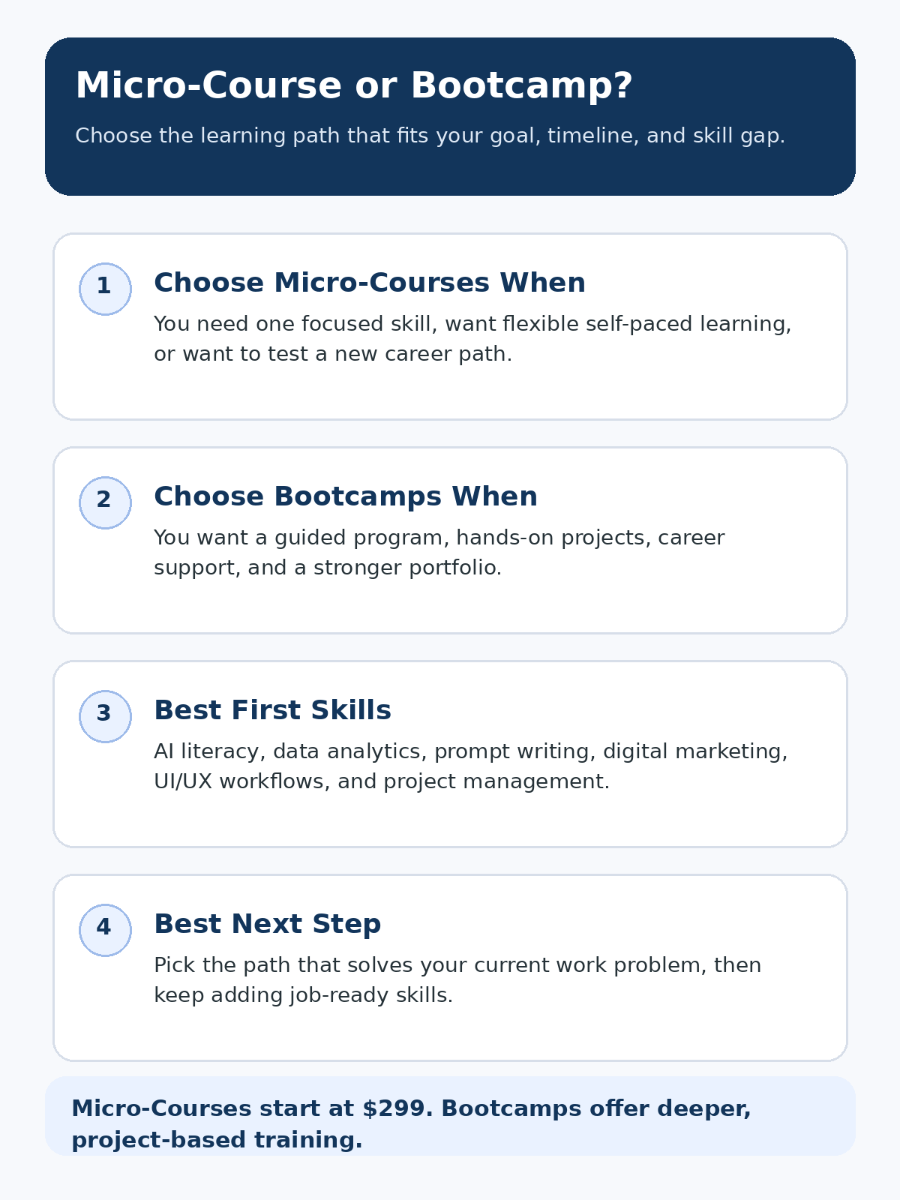
Professionals with narrow task skills face the most risk. Professionals with strong thinking, tool use, and people skills are in a better place. They can use AI as part of their work instead of being pushed aside by it.
This is where AI courses, micro courses, short courses, and online courses help. They help workers close skill gaps before those gaps hurt their careers.
Which professionals are likely to grow with AI?
Will AI replace professionals who keep learning? It is less likely. AI rewards people who can combine tool skills with human skills.
PwC’s 2026 Global AI Jobs Barometer found that the skills needed for AI-exposed jobs are changing more than twice as fast as skills in less exposed jobs. It also found that companies most exposed to AI had 40% higher productivity growth than the least exposed companies.
This points to a clear lesson. AI does not only cut work. It also raises the bar for work.
The best-positioned professionals are those who can use AI, check AI, and explain AI-assisted work. These workers do not just press a button. They guide the tool, review the output, and use their field knowledge to make better choices.
That is why professional development now needs to include AI skills. A worker who upskills in AI can stay useful as job duties change.
What skills matter most in an AI-shaped job market?
Will AI replace professionals who lack new skills? Some may be at risk. The safer path is to build a mix of technical and human skills.
The most useful skills include AI literacy, data thinking, prompt writing, clear communication, critical thinking, ethics, and problem solving. These skills help workers use AI without trusting it blindly.
Brookings reported that many highly AI-exposed U.S. workers also have a strong average capacity to manage job shifts if needed. The report found that about 70% of highly AI-exposed workers were in jobs with high average ability to handle transitions.
That is good news for many U.S. professionals. It means many workers can adapt if they get the right training.
WorkForce Institute’s micro-learning model supports this exact need. Learners can start with one focused skill, build confidence, and add more skills as their goals change.
Micro courses vs bootcamps: which path is right?
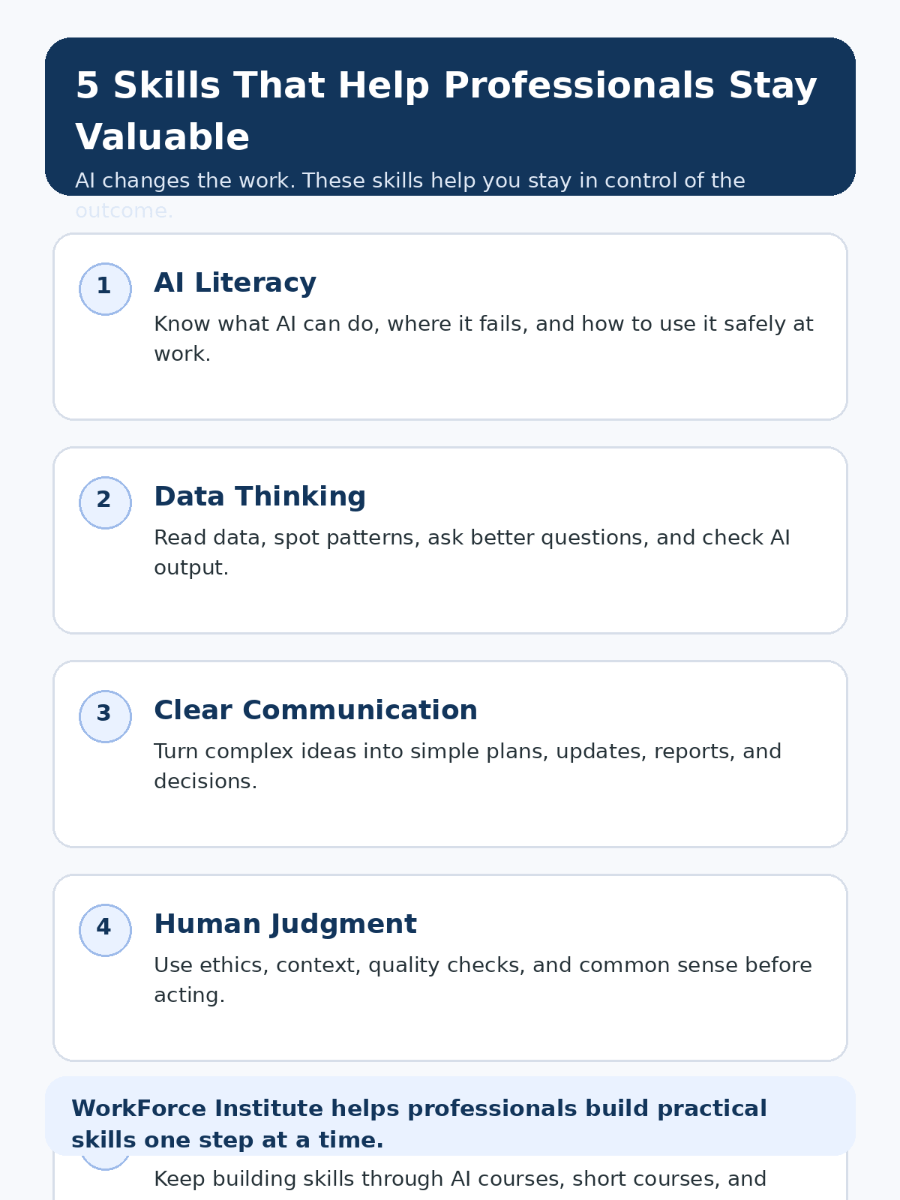
Will AI replace professionals who wait too long to learn? It may not replace them, but it can leave them behind. The best path depends on the size of the skill gap.
WorkForce Institute micro-courses are focused, self-paced modules built around one career-relevant skill. They start at $299, and learners can choose a single module before adding more.
WorkForce Institute bootcamps are better for learners who want a deeper path, more structure, hands-on projects, and career support. The AI-Powered Project Manager Bootcamp, for example, includes live classes, self-paced work, project tasks, and a capstone tied to real project workflows.
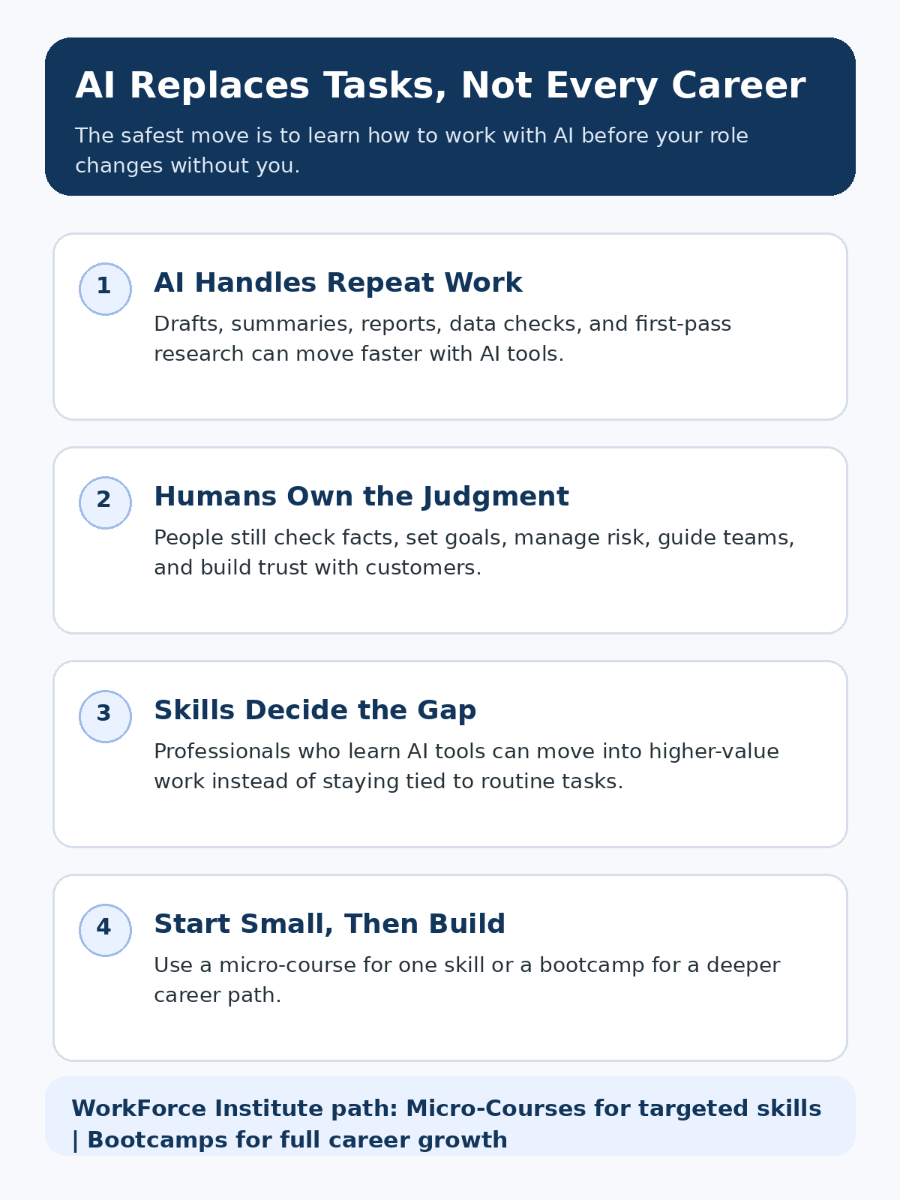
| Career question | Best WFI option | Why it works |
|---|---|---|
| I need one skill now. | Micro courses | You can learn one focused skill without a full program. |
| I want to test an AI career path. | Micro courses | You can start small before making a larger choice. |
| I need a full career shift. | Bootcamp | You get a guided path, projects, and career support. |
| I want a stronger portfolio. | Bootcamp | You build work samples that show what you can do. |
| I am busy and need flexible learning. | Micro courses or online courses | You can learn on your schedule. |
| I want live support and structure. | Bootcamp | You learn with instructors, peers, and project feedback. |
How WorkForce Institute helps answer the AI career question
Will AI replace professionals? WorkForce Institute helps turn that fear into a plan.
The Micro Credentials path is useful when you want a focused skill. Current micro-course categories include UI/UX Design, Digital Marketing, Data Analytics, and Program Management. Learners can also choose modules across categories to build a custom path.
This is helpful for workers who do not want to stop everything and start over. You can learn AI for your current role first. Then you can add more skills as your career goals become clear.
The WorkForce Institute bootcamp path is useful when you want deeper change. WFI offers training across areas such as Generative AI Data Analyst, AI-Enhanced UI/UX Design, Digital Marketing, AI for Software Engineers, and AI-Powered Project Management.
The right path depends on your goal. If you need one skill, start with micro courses. If you need a larger career shift, enroll in a bootcamp.
What should marketers learn?
Will AI replace professionals in marketing? It will replace some routine work, but it will not replace smart marketers who understand strategy, audience needs, data, and content quality.
AI can help draft social posts, email copy, ad ideas, and keyword lists. A marketer still needs to know the audience, choose the message, protect the brand, and measure results.
McKinsey has reported that sales and marketing account for a large share of the potential business value from generative AI. That means marketing teams will keep using AI, and workers will need to know how to use it well.
For marketers, short courses in AI writing, SEO, analytics, and campaign planning can help fast.
A deeper digital marketing bootcamp can help career changers build a broader base.
What should data professionals learn?
Will AI replace professionals in data roles? AI will change data work, but it will not remove the need for people who can ask good questions and explain results.
AI can clean data, build charts, and draft summaries. A data professional still needs to check the source, test the logic, explain the risk, and link the numbers to business choices.
WorkForce Institute offers AI Data Analyst micro-course options on its main site and a Generative AI Data Analyst path for deeper training. The micro-course page lists Data Analytics as one of the current course categories.
This makes data one of the strongest areas for professional development. Workers who learn AI tools and data basics can move into roles that need both.
What should designers learn?
Will AI replace professionals in design? AI can speed up design tasks, but people still lead user research, problem framing, testing, and product choices.
AI can create layout ideas, write sample copy, and test visual options. A designer still needs to understand users. They must know what people need, where they get stuck, and how to create a better experience.
WorkForce Institute lists AI Enhanced UI/UX Design among its micro-course pathways. The site describes skills such as user research, wireframing, prototyping, and AI-powered design workflows.
A micro-course can help a designer add one new workflow. A bootcamp can help a beginner or career changer build a stronger design base.
What should project managers learn?
Will AI replace professionals in project management? AI will take over some project admin tasks, but it will not replace leaders who can manage people, risk, scope, and change.
AI can draft agendas, summarize meetings, build status updates, and create first-pass plans. A project manager still needs to manage tradeoffs, talk to stakeholders, and keep teams aligned.
The WorkForce Institute AI-Powered Project Manager Bootcamp teaches learners to use AI for project charters, plans, reports, stakeholder work, dashboards, and full project workflows.
This is a strong example of how AI changes a role. The job is not gone. The job now needs stronger AI-supported execution.
How to build a simple AI skill plan
Will AI replace professionals who take action now? It is less likely. A simple skill plan can make the shift feel more clear.
Start with your current role. Write down five tasks you do every week. Mark the tasks that are repeatable, text-based, data-based, or report-based. Those are the tasks AI may change first.
Next, pick one skill gap. You may need prompt writing, AI research, data analysis, AI-assisted design, AI project planning, or AI content review.
Then choose the right learning path. Use WorkForce Institute Micro Credentials if you need one skill now. Choose a WorkForce Institute bootcamp if you want a full path with projects, coaching, and career support.
This keeps learning simple. You do not need to master every tool. You need to build the next skill that protects your next career move.
FAQ: Will AI replace every professional?
Will AI replace professionals in the next few years?
Will AI replace professionals completely? No. It will change many jobs and remove some tasks. It will also create demand for workers who know how to use AI well.
Should I take AI courses now?
Yes. AI courses help you understand the tools, limits, and use cases that now show up at work. Start with the skill closest to your current role.
Are micro courses enough?
Micro courses are enough when you need one clear skill. They are a smart first step for busy professionals who want flexible learning.
Are bootcamps better than short courses?
Bootcamps are better when you need depth, projects, guidance, and a career path. Short courses are better when you need a focused skill fast.
Do online courses help with career growth?
Yes, when they teach job-ready skills and give you ways to practice. Online courses work best when they match your role, schedule, and goals.
Final answer: AI will not replace every professional, but it will reward trained professionals
Will AI replace professionals? It will replace some tasks, change many roles, and raise skill needs across the U.S. job market. It will not replace every person who brings judgment, care, skill, and context to the work.
The best move is to learn before the pressure hits. If you want one targeted skill, enroll in WorkForce Institute Micro Credentials. If you want a deeper career path, enroll in a WorkForce Institute bootcamp.
AI will change work. Your skills decide whether that change feels like a threat or an opening.