
Data Analyst vs. Data Scientist: Roles, Skills, and Career Differences
Create Account
Have an account? Login

Introduction
Data is an important part of how businesses understand customers, improve operations, and make decisions. As organizations collect more information, they need professionals who can turn that data into useful insights. Two roles that often come up in this context are data analysts and data scientists.
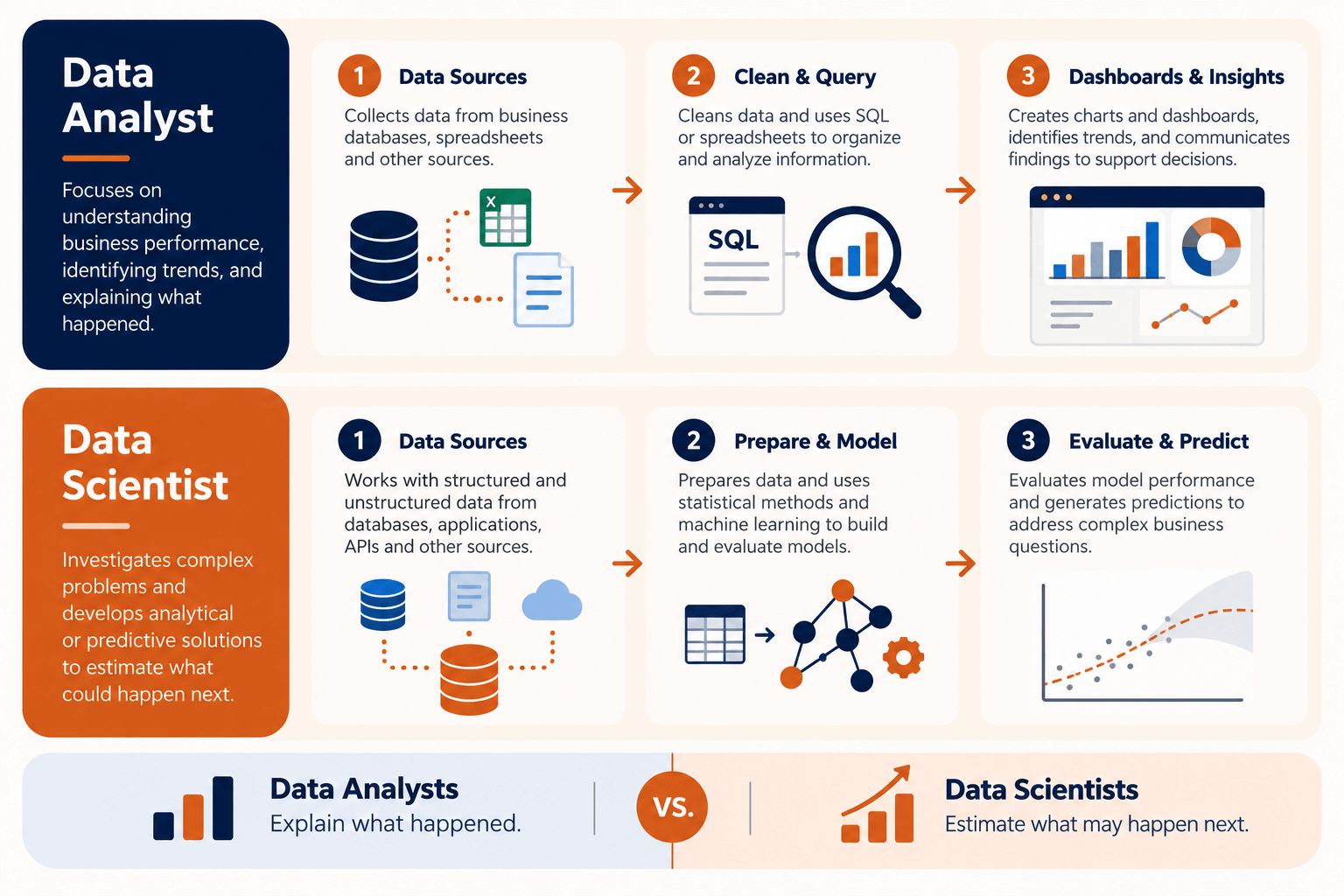
Although data analysts and data scientists both work with data, their responsibilities, methods, and typical projects can differ. Data analysts often focus on understanding existing business performance and explaining what happened. Data scientists may work on more complex analytical problems, including building predictive models to estimate what could happen next.
Understanding the difference between a data analyst vs. data scientist can help students, career changers, and professionals decide which path better matches their interests and skills.
What Is a Data Analyst?
A data analyst collects, organizes, examines, and interprets data to help businesses answer questions and make informed decisions. The role often involves working with existing datasets to identify trends, measure performance, and communicate findings to stakeholders.
For example, a marketing team may want to understand why website traffic increased but sales remained unchanged. A data analyst could review website activity, campaign performance, and conversion data to identify patterns that help explain the results.
Key Responsibilities of a Data Analyst
- Collecting and organizing data from relevant sources.
- Cleaning datasets and checking data quality.
- Using SQL or spreadsheets to query and analyze information.
- Creating dashboards, charts, and reports.
- Identifying trends, patterns, and performance changes.
- Explaining findings to business teams and stakeholders.
- Supporting decisions with evidence from data.
Common Data Analyst Skills
Data analysts need a combination of technical, analytical, and communication skills. Their work often involves understanding business questions and selecting appropriate methods to answer them.
| Skill | How It Is Used |
|---|---|
| SQL | Querying databases and retrieving relevant information. |
| Excel or spreadsheets | Organizing data, calculating metrics, and performing analysis. |
| Data visualization | Presenting patterns and results through charts and dashboards. |
| Statistics | Understanding distributions, averages, variation, and relationships. |
| Business understanding | Connecting analytical findings to business goals and decisions. |
| Communication | Explaining results clearly to people who may not have a technical background. |
What Is a Data Scientist?
A data scientist uses statistical methods, programming, and analytical techniques to investigate complex problems and extract insights from data. Depending on the organization and project, the role may involve developing predictive models, testing hypotheses, or building data-driven solutions.
Data scientists may work with structured data, such as database tables, as well as less structured information, such as text or customer feedback. They often explore whether data can help answer questions that are difficult to address through basic reporting alone.
For example, a subscription business may want to estimate which customers are more likely to cancel their subscriptions. A data scientist could investigate historical customer behavior, develop a predictive model, and evaluate how accurately it identifies patterns associated with churn.
Key Responsibilities of a Data Scientist
- Exploring complex datasets to identify useful patterns.
- Applying statistical analysis and experimentation.
- Developing and evaluating machine learning models where appropriate.
- Creating predictive or classification models for business problems.
- Preparing data for modeling and analysis.
- Communicating model results, assumptions, and limitations.
- Collaborating with analysts, engineers, and business teams.
Common Data Scientist Skills
| Skill | How It Is Used |
|---|---|
| Python or R | Analyzing data, building workflows, and developing models. |
| Statistics and probability | Evaluating relationships, uncertainty, and model performance. |
| Machine learning | Building models that learn patterns from data for specific tasks. |
| Data preparation | Combining, cleaning, and transforming data for analysis. |
| Model evaluation | Checking whether a model performs reliably for its intended use. |
| Problem-solving | Translating business questions into analytical approaches. |
Data science roles vary considerably. Some focus on experimentation and statistical analysis, while others involve machine learning, software development, or deploying models into production. Not every data scientist spends most of their time building advanced AI systems.
Data Analyst vs. Data Scientist: Key Differences
The main difference between a data analyst and a data scientist is the type of questions they typically address and the methods they use. These roles overlap, and responsibilities depend on the organization, but the following comparison provides a useful starting point.
| Area | Data Analyst | Data Scientist |
|---|---|---|
| Primary focus | Understanding business performance and explaining patterns in data. | Investigating complex problems and developing analytical or predictive solutions. |
| Typical questions | What happened? Where did performance change? Why might it have happened? | What patterns can we learn? What might happen next? Can a model help solve this problem? |
| Data work | Often works with structured business datasets and reporting data. | May work with structured, unstructured, or combined datasets. |
| Common methods | SQL queries, descriptive statistics, dashboards, and business analysis. | Statistical modeling, experimentation, machine learning, and predictive analysis. |
| Typical tools | SQL, Excel, Power BI, Tableau, and sometimes Python or R. | Python, R, SQL, machine learning libraries, and model evaluation tools. |
| Common deliverables | Reports, dashboards, business insights, and recommendations. | Models, experiments, analytical findings, and predictive systems. |
These differences are not strict boundaries. A data analyst may build forecasts or use Python, while a data scientist may create dashboards or conduct descriptive analysis. Job descriptions should be reviewed carefully because titles alone do not always reflect the actual work.
Data Analyst vs. Data Scientist: A Practical Example
Imagine an online learning company notices that fewer students are completing its courses.
What a Data Analyst Might Do
A data analyst could investigate course completion rates across different programs, compare student engagement over time, and identify where learners tend to stop progressing.
The analyst might find that many students leave a course after a particular module. They could examine lesson length, quiz results, and feedback to help the learning team understand where the experience may need improvement.
What a Data Scientist Might Do
A data scientist could explore whether historical learning activity contains patterns associated with students who are likely to stop engaging. After preparing relevant data, the scientist might develop and evaluate a model that estimates the likelihood of a learner becoming inactive.
The company could then review the model's findings and test whether useful interventions, such as additional learning support or clearer course guidance, improve student outcomes.
In this example, the data analyst helps explain patterns in course performance, while the data scientist investigates whether those patterns can support a predictive approach. Both roles can contribute to better decisions.
Which Career Path Should You Choose?
The right path depends on your interests, current skills, and the kind of problems you want to solve. Neither role is universally better than the other.
Data Analytics May Be a Good Fit If You:
- Enjoy working with business questions and practical problems.
- Like organizing data and identifying trends.
- Want to communicate insights through reports and dashboards.
- Prefer a career path that can begin with SQL, spreadsheets, statistics, and visualization skills.
Data Science May Be a Good Fit If You:
- Enjoy programming and mathematical problem-solving.
- Want to explore statistical methods and machine learning.
- Are interested in building and evaluating predictive models.
- Like investigating complex questions that may require experimentation or advanced analysis.
These are general considerations rather than strict requirements. People can move between analytics and data science as they gain experience, develop new skills, and take on different responsibilities.
How to Start a Career in Data Analytics or Data Science
Both career paths benefit from a strong foundation in data handling, analytical thinking, and communication. A practical learning plan can help you build those skills gradually.
- Learn the fundamentals. Understand data types, basic statistics, data quality, and how businesses use data to make decisions.
- Build SQL skills. Practice filtering, joining, grouping, and summarizing data from databases.
- Develop visualization skills. Create charts and dashboards that communicate findings clearly.
- Learn programming as needed. Python or R can support more advanced analysis, automation, and data science workflows.
- Practice with projects. Use real or publicly available datasets to investigate a question, explain your method, and present your findings.
- Create a portfolio. Show your projects, the questions you investigated, the tools you used, and what you learned.
For a practical starting point, read WFI's guide to building a career in data science. It explores initial steps for people considering a data science career.
You can also explore WFI's article on the evolving role of data analysts and generative AI to learn how tools and workflows are changing analytical work.
Frequently Asked Questions
Is a data analyst the same as a data scientist?
No. The roles overlap, but data analysts often focus on interpreting business data and reporting findings, while data scientists may investigate more complex problems using statistical modeling and machine learning.
Do data analysts need to know Python?
Python can be useful for data analysts, particularly for automation and more advanced analysis. However, many analyst roles emphasize SQL, spreadsheets, visualization tools, and business understanding. Requirements vary by employer.
Do data scientists need machine learning?
Machine learning is important for many data science roles, especially those involving prediction or classification. However, data science also includes statistics, experimentation, data preparation, and analytical problem-solving. The exact requirements depend on the role.
Can a data analyst become a data scientist?
Yes. A data analyst can build toward data science responsibilities by developing programming, statistics, modeling, and machine learning skills. Experience with business data and analytical problem-solving can provide a useful foundation.
Which career is better for beginners?
There is no single answer. Data analytics may be a suitable starting point for people who enjoy business analysis, reporting, and visualization. Data science may appeal to people who are interested in programming, statistics, and modeling. Review job requirements and learning goals before choosing.
Conclusion
Data analysts and data scientists both help organizations make better use of data, but they often approach business questions in different ways. Data analysts commonly focus on understanding performance, identifying trends, and communicating insights. Data scientists may use statistical methods and machine learning to investigate complex problems and estimate possible future outcomes.
Choosing between data analyst vs. data scientist careers comes down to your interests and the skills you want to develop. By learning data fundamentals, practicing with projects, and exploring the work involved in each role, you can make a more informed decision about your next step.